


HIIT vs Cardio: Which Workout Fits Your Fitness Goals?
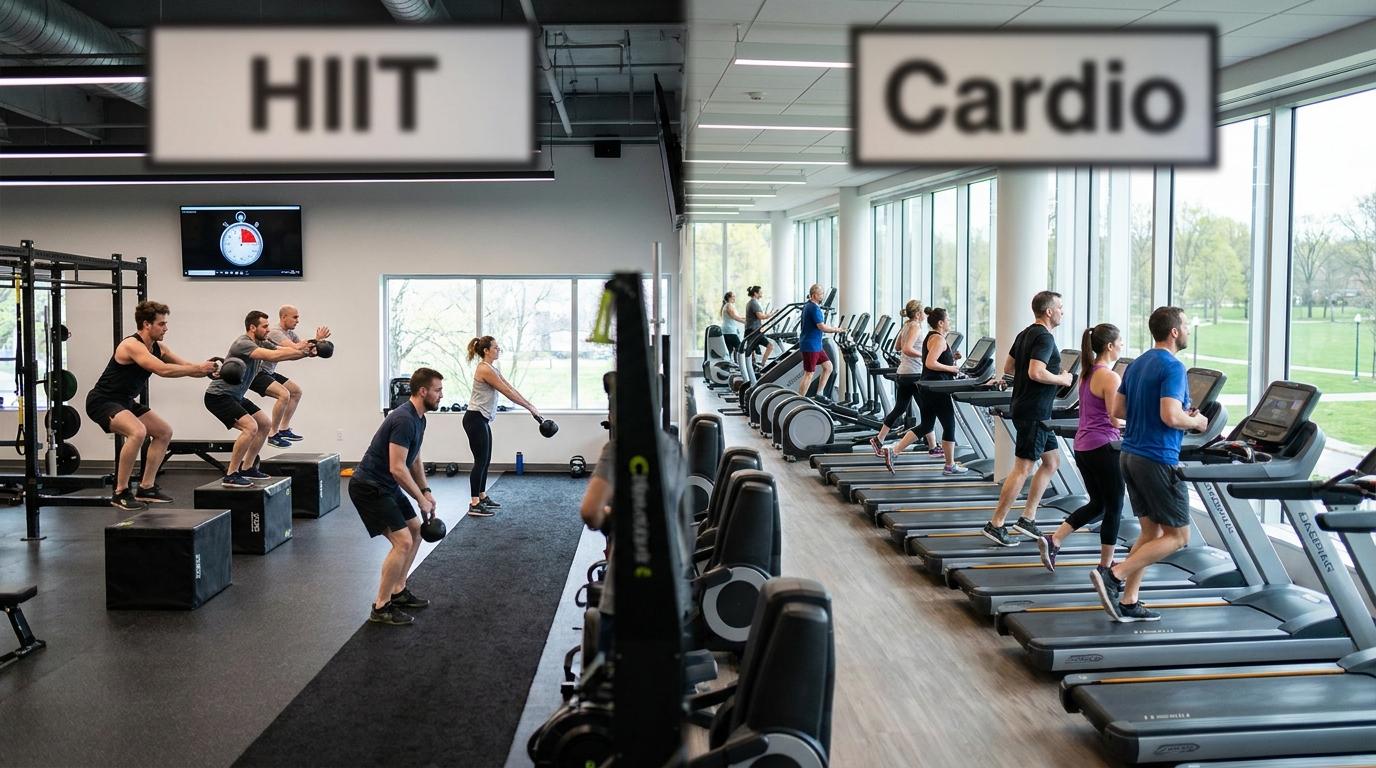
Choosing between a hard interval workout and a steady cardio session is not simply a matter of picking the workout that feels more difficult. The right choice depends on your fitness goal, current ability, available time and how consistently you can train.
That is the useful way to look at HIIT vs cardio.
High-intensity interval training (HIIT) alternates periods of vigorous exercise with recovery. Traditional cardio, often described in research as moderate-intensity continuous training (MICT), involves maintaining a more consistent intensity for a longer period.
Both approaches can improve cardiorespiratory fitness and contribute to a more active lifestyle. Research comparing them has also found that results can vary depending on the person, training protocol and amount of exercise performed.
For adults in Canada, the current recommendation is at least 150 minutes of moderate-to-vigorous physical activity each week. The guidelines also include muscle-strengthening activity at least twice a week for adults aged 18 to 64.
HIIT and Traditional Cardio Explained
HIIT uses repeated changes in exercise intensity.
A workout might include a period of hard running followed by easier walking, or hard cycling followed by slower pedalling. The length of each interval depends on the program.
Examples include:
-
Running intervals
-
Cycling intervals
-
Rowing intervals
-
Bodyweight circuits
-
Treadmill intervals
-
Low-impact interval workouts
Traditional cardio takes a different approach. Instead of repeatedly increasing and reducing effort, you maintain a relatively steady pace.
Examples include:
-
Brisk walking
-
Continuous jogging
-
Cycling
-
Swimming
-
Hiking
-
Elliptical training
-
Treadmill walking
The important difference in HIIT vs traditional cardio is not the exercise itself. Running, for example, can be performed as either continuous cardio or interval training. The difference comes from how the intensity and recovery periods are structured.
Which Workout Is Better for General Fitness?
Both can improve aerobic fitness.
A 2023 systematic review and meta-analysis of 29 randomized controlled trials found significant improvements in body composition and cardiorespiratory fitness with both HIIT and moderate-intensity continuous training. HIIT showed some advantages for waist circumference, percentage body fat and VO₂peak, although the researchers noted that the clinical significance of these differences was limited.
However, the results are not identical in every group.
A separate meta-analysis involving adults with overweight or obesity found no significant difference between HIIT and moderate-intensity continuous training for cardiorespiratory fitness.
This is important when interpreting HIIT vs cardio research. A workout that produces a larger improvement in one group may not produce the same result in another.
Fitness level, age, health status, exercise type, interval length and weekly training volume can all influence the outcome.
If Your Goal Is Fat Loss
Fat loss is one of the most common reasons people compare HIIT with traditional cardio.
The research does not support the simple claim that HIIT always burns more body fat.
A 2023 systematic review and meta-analysis of 11 randomized controlled trials involving adults with overweight or obesity found no significant difference between HIIT and continuous aerobic training for percentage body fat or abdominal visceral fat. HIIT did show greater improvements in some secondary outcomes, including VO₂max.
Earlier research reached a similar conclusion. A meta-analysis of 13 studies found that both HIIT and moderate-intensity continuous training reduced whole-body fat mass and waist circumference, but there were no significant differences between the two approaches across the body-composition measures studied.
More recent research suggests that the picture can change depending on the HIIT program.
A 2026 network meta-analysis of 18 studies found that HIIT performed for at least 75 minutes per week was associated with lower body-fat percentage, waist circumference and improved VO₂max compared with control conditions in adults with overweight or obesity. However, the studies lasted only 8 to 16 weeks, and the certainty of evidence varied from moderate to low.
So the practical answer is not that HIIT is automatically better for fat loss.
Both types of exercise can help. The bigger question is whether the workout can be performed regularly while supporting an appropriate overall diet and activity level.
If You Have Limited Time
This is where HIIT can have a practical advantage.
High-intensity intervals allow you to spend more of a short workout exercising at a vigorous intensity. That can make HIIT appealing to people who have limited time during the week.
Research also provides some support for this advantage. A systematic review of overweight and obese adults found similar body-composition improvements from HIIT and moderate-intensity continuous training, while HIIT required about 40% less training time in the included studies.
That does not mean a five-minute HIIT workout is equivalent to every longer cardio session.
The total workout still includes warming up, recovery periods and cooling down. You also need to consider recovery between hard sessions.
For someone who has only a small amount of time available, however, interval training can be a useful way to include vigorous activity.
If Your Goal Is Endurance
Traditional cardio can be particularly useful when the goal involves sustaining exercise for longer periods.
A runner preparing for a longer distance needs time spent running. A cyclist preparing for a long ride needs time on the bike. Someone building basic aerobic endurance may benefit from gradually increasing the duration of walking, cycling or jogging.
HIIT can still have a place in endurance training because it challenges the cardiovascular system through repeated high-effort intervals.
The two approaches simply provide different training stimuli.
Someone training for a long-distance event may therefore use longer steady sessions as the foundation while adding selected interval workouts. Someone exercising mainly for general health may not need the same volume of endurance-specific training.
If You Are a Beginner
For a beginner, traditional cardio can be easier to control.
Walking is a good example. You can adjust the pace, distance and duration without needing to perform repeated maximal efforts.
Cycling and other low-impact activities can also be adjusted according to fitness level.
That does not mean beginners cannot perform HIIT.
Interval training can be modified by reducing the intensity and extending the recovery period. A beginner might alternate between faster walking and slower walking instead of sprinting.
The goal should be gradual progression.
If you have been inactive for a long time or have concerns about vigorous exercise, it is sensible to seek appropriate professional guidance before starting demanding interval training.
HIIT vs Cardio for Calorie Burn
There is no universal winner when comparing calorie expenditure.
The amount of energy used during exercise depends on factors such as:
-
Body size
-
Exercise intensity
-
Workout duration
-
Exercise type
-
Fitness level
-
Total weekly activity
HIIT can produce a high rate of energy expenditure during the hard intervals. Traditional cardio can accumulate substantial energy expenditure because the activity continues for longer.
This means that comparing two workouts only by their intensity does not tell the whole story.
For example, a short interval session and a longer cycling session may both have a place in a weekly routine. The more useful question is which one allows you to maintain regular physical activity.
For weight management, exercise is only one part of the picture. Food intake, daily movement and long-term consistency also influence body weight.
Recovery Matters
One of the biggest practical differences between HIIT and traditional cardio is how hard each session feels and how easily it can be repeated.
Hard intervals place a greater immediate demand on the body. If every workout is performed at high intensity, fatigue can accumulate and affect subsequent training.
Moderate cardio provides another option for staying active without making every session highly demanding.
For example, a week could include:
-
One or two HIIT sessions
-
Moderate walking or cycling
-
Strength training
-
Easier movement or recovery days
There is no requirement for every workout to be intense.
A sustainable training routine should allow enough recovery to continue exercising consistently.
What About Cardiovascular Health?
Both aerobic and vigorous physical activity contribute to cardiovascular fitness.
Canadian health guidance recommends accumulating at least 150 minutes of moderate-to-vigorous physical activity each week for adults. The government also notes that increasing physical activity can support heart and lung function and help with healthy weight management.
This means your weekly activity does not need to come from one specific training method.
Brisk walking, cycling, jogging, swimming and interval training can all contribute to physical activity.
For someone who currently does very little exercise, adding regular moderate activity may be more realistic than immediately trying to complete several demanding HIIT workouts.
Can You Use Both?
Yes.
There is no reason to treat HIIT vs cardio as a permanent choice between two competing forms of exercise.
Combining them can make a weekly routine more flexible.
For example, someone could perform moderate cycling on one day, HIIT later in the week and strength training on separate days. Another person might prefer walking several days a week with one interval session.
The right combination depends on your goal.
If endurance is the priority, longer continuous sessions may deserve more attention. If time is limited, HIIT can provide a practical way to add vigorous exercise. If you are new to exercise, moderate cardio may provide an easier starting point.
Which Workout Fits Your Goal?
The best answer to HIIT vs cardio becomes clearer when you match the training method to your objective.
Choose HIIT if you want to:
-
Fit vigorous exercise into a shorter workout
-
Add interval training to your routine
-
Challenge your cardiovascular fitness
-
Vary the intensity of your sessions
-
Perform structured workouts rather than continuous exercise
Choose traditional cardio if you want to:
-
Build aerobic endurance
-
Start with manageable exercise
-
Walk, cycle, swim or jog at a steady pace
-
Control intensity more easily
-
Accumulate more continuous exercise time
Consider combining both if you want to:
-
Build general fitness
-
Add variety to your training
-
Include both moderate and vigorous activity
-
Adjust your workouts around your schedule and recovery
There is no requirement to stay with one method.
The Practical Takeaway
The evidence behind HIIT vs cardio is more balanced than many fitness headlines suggest.
HIIT can improve cardiorespiratory fitness and may offer a time-efficient way to perform vigorous exercise. Traditional cardio can also improve aerobic fitness and provides an accessible way to increase weekly physical activity. Studies comparing the two have found similar results for several measures, while some outcomes favour HIIT depending on the population and training program.
For fat loss, neither method should be treated as a guaranteed shortcut. Multiple reviews have found that HIIT and continuous aerobic training can produce similar body-composition changes, while newer evidence suggests certain HIIT programs may have additional benefits in specific populations.
For Canadians, the bigger priority is meeting the recommended amount of weekly physical activity and choosing activities that can be maintained over time. Adults should aim for at least 150 minutes of moderate-to-vigorous physical activity each week.
If you are interested in adding interval training to your routine, read our HIIT workout for beginners guide for practical guidance on exercise selection, work and recovery periods, and how to progress your workouts based on your fitness level.

 French