


RWA Tokenization Business Model: Where Can Companies Generate Revenue?
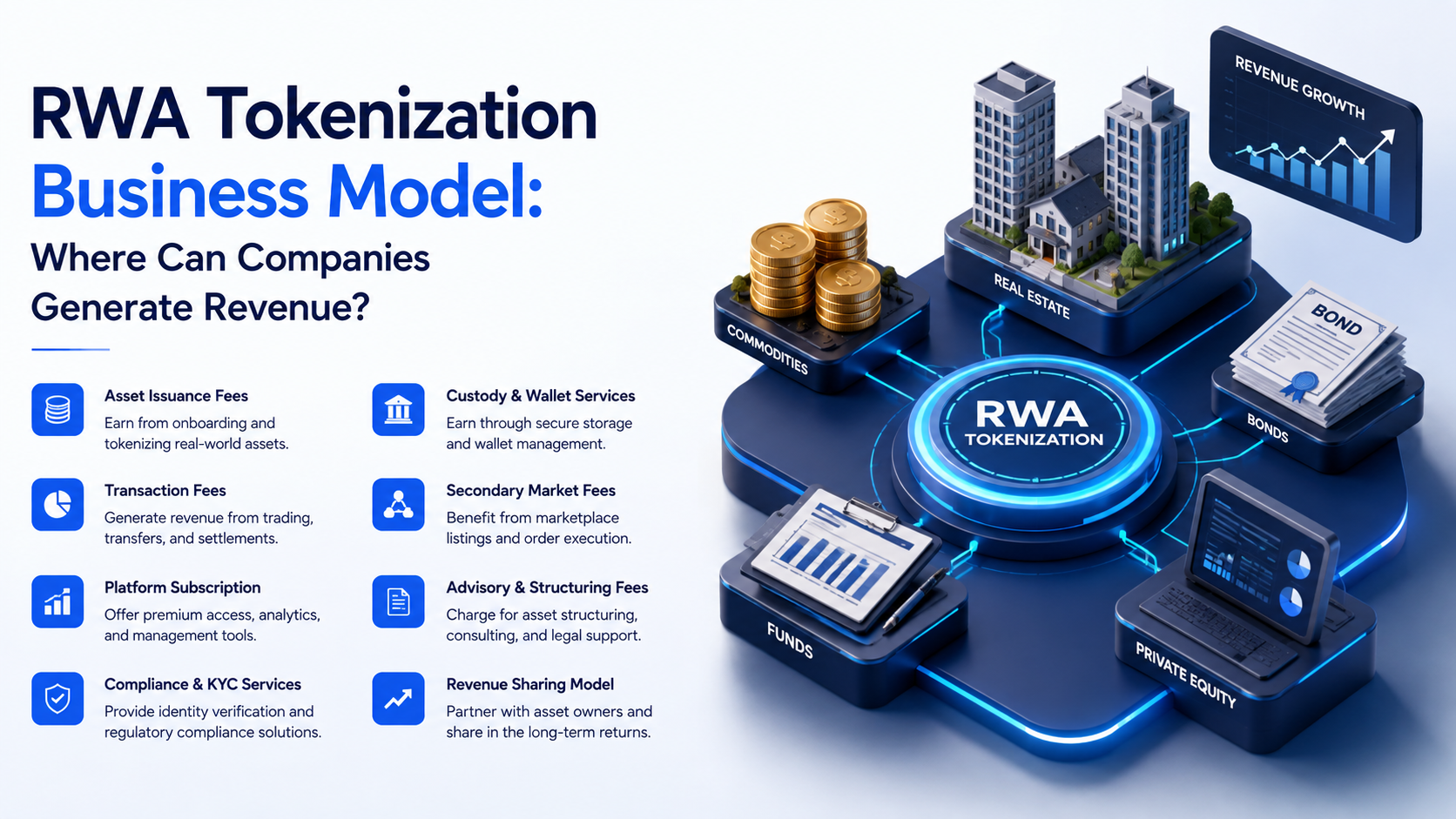
The growth of blockchain-based asset ownership has created new business opportunities around physical and financial assets. Real estate, private credit, commodities, art, infrastructure, funds, and other asset classes can be represented digitally through tokenization. This has created demand for platforms that can issue, manage, trade, and administer digital representations of real-world assets.
For companies entering this market, the technology is only one part of the business. A sustainable business model depends on how the company earns money from issuers, investors, asset managers, trading participants, and other users. RWA Tokenization can support several revenue channels, ranging from token issuance fees to transaction charges and recurring platform subscriptions.
A company does not necessarily need to depend on a single source of income. It can combine issuance fees, marketplace commissions, custody charges, compliance services, management fees, and software subscriptions based on its target customers. This article examines the major revenue opportunities available in the RWA Tokenization business and explains how companies can structure their offerings.
1. Token Issuance Fees
Token issuance can be one of the first revenue sources for an RWA business. Asset owners usually need technical infrastructure to convert ownership rights or economic interests into blockchain-based tokens. The provider may charge a fixed fee, a percentage of the asset value, or a combination of both.
The fee can cover token creation, smart contract deployment, asset onboarding, wallet integration, investor allocation, documentation support, and platform configuration. Pricing may differ according to the asset class and the complexity of the issuance process.
For example, tokenizing a commercial property may involve different requirements from tokenizing private credit or a commodity fund. A company can therefore create separate pricing packages for different asset categories.
2. Platform Subscription Revenue
Companies can offer RWA platforms under monthly or annual subscription plans. This model works particularly well for asset managers, investment firms, financial companies, and businesses that plan to conduct multiple tokenization projects.
Subscription packages can include investor dashboards, token management, portfolio tracking, reporting, user administration, transaction monitoring, and analytics. Higher plans can provide additional users, larger transaction limits, reporting functions, and administrative features.
Recurring subscriptions provide predictable income compared with depending entirely on individual token launches. A provider can also offer different plans for startups, mid-sized firms, financial institutions, and enterprise users.
3. Transaction Fees
Every purchase, sale, transfer, or redemption of tokenized assets can potentially generate transaction revenue. The platform may charge a fixed amount per transaction or take a small percentage of the transaction value.
For example, an investor purchasing tokenized real estate units may pay a transaction fee when buying the tokens. A secondary transfer may also generate another fee. If a platform attracts a large number of recurring transactions, these small charges can become a significant source of revenue.
The company should keep its pricing structure easy to understand. Excessively complicated charges can discourage users and make the platform less attractive to asset issuers and investors.
4. Marketplace and Secondary Trading Fees
A tokenization business can generate additional income by providing a marketplace where eligible investors can buy and sell tokenized assets. Instead of relying only on primary issuance, the company can earn revenue whenever assets change hands on its marketplace.
Marketplace revenue may come from listing charges, trading commissions, settlement fees, or withdrawal charges. Different rates can be applied to issuers, buyers, sellers, institutional investors, and other participants.
Secondary markets are particularly relevant because investors may want an exit option after purchasing tokenized assets. A marketplace can therefore become an important part of the company's revenue structure when regulations and asset characteristics permit secondary trading.
5. Asset Management Fees
Some RWA businesses can earn recurring income by managing tokenized investment products. This approach is relevant to tokenized funds, real estate portfolios, private credit pools, and other managed investment structures.
The company may charge a management fee based on assets under management. For instance, an asset manager could receive an annual percentage of the value represented through its tokenized investment products.
Additional charges may apply for portfolio administration, reporting, investor communications, distributions, and other operational activities. This model gives companies an opportunity to generate recurring revenue while maintaining relationships with asset owners and investors.
6. Custody and Wallet Services
Tokenized assets require digital wallets and appropriate asset custody arrangements. Businesses can offer wallet management and custody-related services as separate paid services or include them in higher platform plans.
Revenue may come from account fees, custody charges, transfer fees, or institutional wallet services. The exact structure depends on the assets, jurisdiction, regulatory framework, and type of custody arrangement.
For institutional clients, custody can become a significant service area because organizations may require controlled access, approval workflows, transaction records, and administrative permissions.
7. Compliance and KYC Services
RWA Tokenization involves more than issuing blockchain tokens. Companies often need procedures for investor verification, identity checks, eligibility screening, transaction monitoring, and regulatory reporting.
A provider can offer compliance functions as part of its RWA Tokenization Services. These may include KYC onboarding, investor accreditation checks, AML screening, document verification, whitelist management, and compliance reporting.
Companies can charge per verification, per investor, or through monthly service packages. This creates another revenue channel while addressing a major operational requirement for tokenized asset platforms.
8. Smart Contract Development
Smart contracts are used to define how tokens are issued, transferred, restricted, redeemed, or distributed. Businesses with blockchain development capabilities can generate revenue by creating smart contracts for different asset classes.
RWA token development may involve issuance contracts, compliance restrictions, dividend distribution logic, voting mechanisms, redemption functions, and transfer controls.
A company can charge separately for smart contract design, development, testing, deployment, auditing coordination, and maintenance. The pricing can vary depending on the number of contracts and the functions required by the asset issuer.
9. White Label Tokenization Platforms
Another business model involves providing a ready-to-operate platform that companies can launch under their own brand. Financial firms, investment companies, real estate businesses, and asset managers may prefer this approach when they want to enter the tokenization market without creating an entire technology stack internally.
A white label offering can generate revenue through an initial licensing fee followed by recurring maintenance or subscription charges. Additional fees may apply for branding, integrations, feature additions, compliance modules, and technical support.
For an RWA tokenization development company, this model can create both initial and recurring revenue from the same client.
10. API and Infrastructure Fees
Some businesses may not want to operate a complete tokenization platform. Instead, they may need specific infrastructure components such as token issuance APIs, wallet APIs, investor onboarding systems, blockchain connectivity, or transaction management tools.
A provider can charge based on API calls, active users, transaction volume, or monthly usage. This approach allows other companies to integrate tokenization functionality into their existing financial applications.
API-based pricing can also support multiple customer segments because smaller companies can start with lower usage and increase their plan as activity grows.
11. Listing and Asset Onboarding Charges
Asset issuers may pay fees to list their tokenized products on a platform. The charge can cover due diligence coordination, asset documentation, token configuration, metadata management, investor presentation pages, and onboarding assistance.
For example, a real estate company bringing a tokenized property to an investment marketplace may pay a listing fee before investors can access the offering.
The provider can create different listing packages according to asset value, investor reach, documentation requirements, and marketplace exposure.
12. Distribution and Investor Access Fees
Tokenized assets can be distributed to eligible investors through digital platforms. A company can earn revenue by connecting asset issuers with qualified investor groups.
Revenue can come from distribution commissions, placement fees, investor onboarding charges, or a percentage of funds raised. This model is particularly relevant for investment firms and platforms that maintain relationships with investors.
The business must account for applicable securities, financial promotion, and investment regulations when structuring such fees.
13. Token Redemption and Exit Fees
Token holders may eventually want to redeem their positions, depending on the structure of the asset. A platform can charge a redemption or exit fee when tokens are exchanged for an underlying economic interest, cash distribution, or another approved settlement method.
Redemption charges should be disclosed before investors participate. The company can also include different rates for early redemption, scheduled maturity, or other exit scenarios.
This revenue stream can be useful for private credit, funds, real estate structures, and other assets with defined investment periods.
14. Data, Analytics, and Reporting Services
Tokenized asset platforms generate data related to ownership, transactions, portfolio activity, investor participation, distributions, and asset performance. Companies can provide reporting and analytics tools as paid services.
Institutional clients may require portfolio reports, transaction histories, investor statements, asset-level information, and compliance records. These services can be included in subscription packages or sold separately.
A company can also provide specialized dashboards for asset managers, issuers, administrators, and investors, depending on their reporting requirements.
15. Consulting and Tokenization Strategy Services
Not every asset owner knows how to structure a tokenization project. Companies can generate revenue by providing consulting services before development begins.
Consulting can cover asset selection, token structure, investor models, jurisdiction selection, technical architecture, compliance planning, platform requirements, and launch strategy.
A provider offering Real World Asset Tokenization Services can use consulting as an entry-level service and later provide development, deployment, and maintenance services to the same client.
How Companies Can Combine Revenue Streams
A practical RWA business model does not have to depend on one revenue channel. A company can combine several sources based on its customer type.
For example, an RWA Tokenization Company could charge an asset issuer an initial tokenization fee, collect a monthly platform subscription, receive transaction fees from trading activity, and charge additional fees for investor verification and reporting.
Another company may focus on infrastructure and offer RWA tokenization development services through licensing, API usage, smart contract development, and maintenance contracts.
Asset managers may follow another route by combining management fees, issuance charges, and marketplace commissions. The right model depends on whether the business primarily serves asset owners, investors, financial institutions, technology companies, or marketplace operators.
Factors That Affect Revenue Potential
Revenue potential depends on several factors. The first is the type of asset being tokenized. Real estate, private credit, funds, commodities, and collectibles have different structures and investor requirements.
The target market also matters. A platform serving institutional clients may generate higher contract values than a platform targeting smaller issuers. Transaction frequency is another consideration. A business handling frequent secondary trading can generate recurring transaction income, while a platform focused on occasional large issuances may depend more heavily on issuance fees.
Regulatory requirements, operating costs, blockchain infrastructure, custody arrangements, compliance operations, and customer acquisition expenses should also be considered when setting prices.
Choosing the Right RWA Business Model
The most suitable model depends on the company's position in the market. A technology provider may focus on licensing, subscriptions, APIs, and development services. A marketplace may concentrate on listing, transaction, and trading fees. An asset manager may rely more heavily on management fees and performance-related income where permitted.
Companies offering RWA tokenization development can also combine software development with consulting and maintenance. Meanwhile, a specialized RWA tokenization development company can provide end-to-end services covering smart contracts, investor onboarding, asset management, and marketplace functions.
The business model should match the value delivered to customers. Fees should reflect the amount of technology, compliance work, administration, and ongoing support involved in each service.
Conclusion
RWA Tokenization creates several ways for companies to generate revenue, including token issuance fees, subscriptions, transaction charges, marketplace commissions, asset management fees, custody services, compliance services, smart contract development, white label platforms, API usage, asset listing, investor distribution, redemption services, analytics, and consulting. A company does not need to depend on one income source when its platform supports multiple activities across the tokenized asset lifecycle. The right approach depends on the target asset class, customer segment, regulatory environment, transaction volume, and services offered. Companies entering this market should evaluate their technology and operating costs alongside expected revenue before selecting a model. Blockchain App Factory provides RWA tokenization development services for businesses seeking to create platforms and solutions for tokenized real-world assets.
FAQs
1. What is an RWA Tokenization business model?
An RWA Tokenization business model defines how a company earns income from services related to converting real-world assets into blockchain-based tokens. Revenue can come from issuance, subscriptions, transactions, marketplace activity, custody, compliance, and other services.
2. How does an RWA Tokenization Company make money?
An RWA Tokenization Company can generate revenue through token issuance charges, platform subscriptions, transaction fees, marketplace commissions, smart contract development, compliance services, custody, asset management, consulting, and API usage.
3. What are RWA Tokenization Services?
RWA Tokenization Services can include asset token creation, smart contract development, investor onboarding, wallet integration, compliance functions, token management, marketplace development, asset administration, and platform maintenance.
4. Is RWA token development a profitable business?
RWA token development can create several revenue opportunities because companies may charge for development, deployment, maintenance, smart contracts, integrations, and additional platform functions. Profitability depends on customer demand, operating expenses, pricing, and the regulatory market.
5. What does RWA tokenization platform development include?
RWA tokenization platform development can include user management, asset onboarding, token issuance, smart contracts, investor verification, wallets, transaction management, dashboards, reporting, compliance functions, and marketplace features.
6. Can companies earn recurring revenue from tokenization platforms?
Yes. Companies can generate recurring revenue through monthly subscriptions, maintenance plans, custody charges, API usage, asset management fees, transaction charges, and compliance services.
7. Why are compliance services important for RWA platforms?
Tokenized assets may involve financial regulations and investor eligibility requirements. Compliance services can support identity verification, AML screening, investor checks, transaction monitoring, and related administrative processes.
8. What is the role of an RWA tokenization development company?
An RWA tokenization development company can provide technology services for creating tokenization platforms, smart contracts, investor systems, wallets, marketplaces, APIs, and other components required for managing tokenized assets.
9. How can a company monetize a tokenized asset marketplace?
A marketplace can earn money through listing fees, transaction commissions, trading charges, settlement fees, asset onboarding charges, and other platform services, subject to the applicable regulatory framework.
10. What are Real World Asset Tokenization Services used for?
Real World Asset Tokenization Services are used to represent assets such as real estate, private credit, commodities, funds, infrastructure, and other eligible assets through blockchain-based tokens and related digital infrastructure.

 English