


IT Certification Practice Tests: How They Improve Exam Readiness
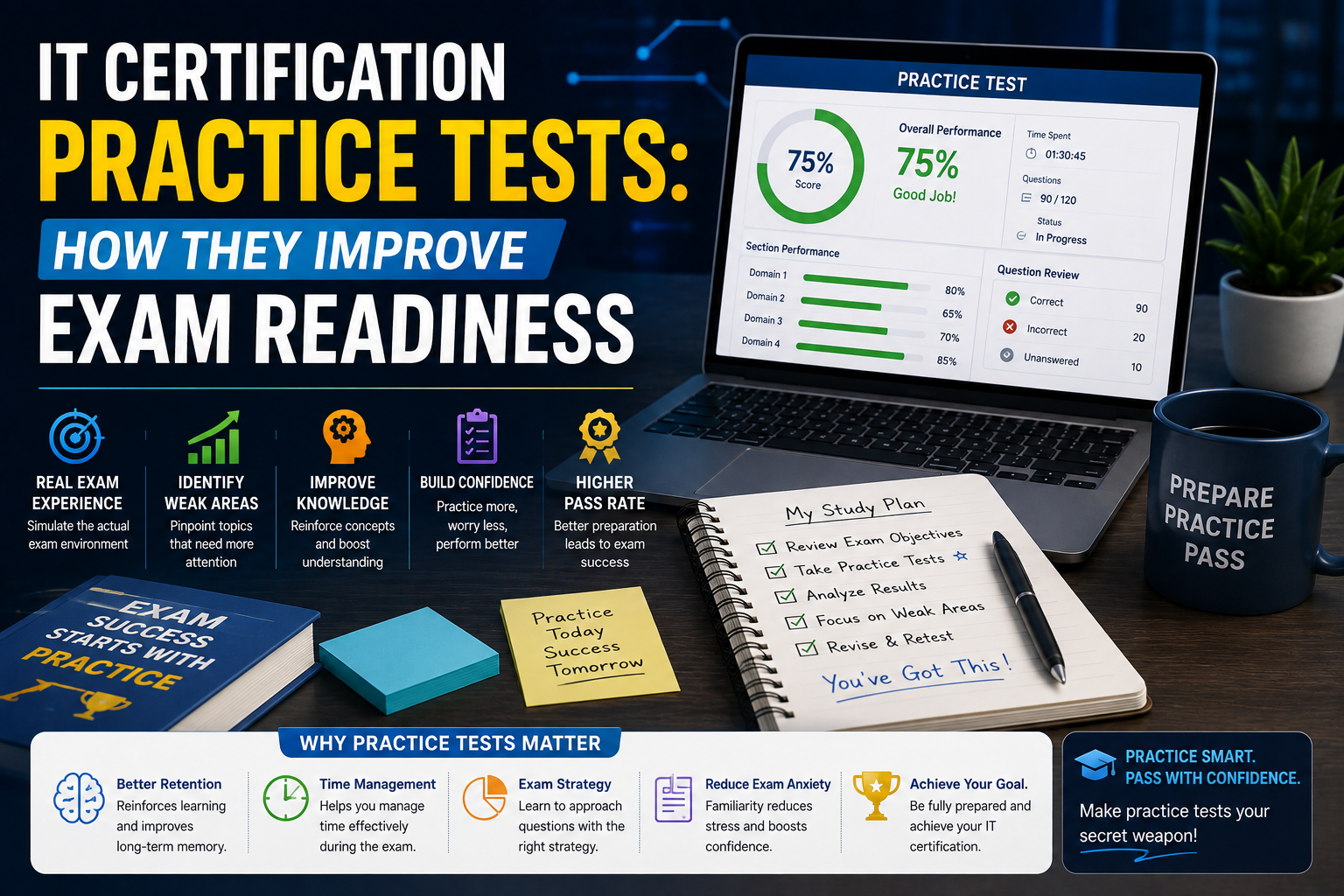
IT certification practice tests are one of the most useful tools for measuring exam readiness before the real test. They help candidates move beyond passive study by testing recall, scenario analysis, time management, and the ability to choose the best answer under pressure.
Used correctly, practice tests can reveal weak topics, improve confidence, and make final revision more focused. However, their value depends on how they are used. Repeatedly memorizing answers is far less effective than reviewing mistakes, understanding explanations, and connecting missed questions back to official exam objectives.
What Are IT Certification Practice Tests?
IT certification practice tests are simulated assessments designed to resemble the structure, style, and difficulty of certification exams.
They may include:
-
Multiple-choice questions
-
Multiple-select questions
-
Scenario-based questions
-
Performance-style exercises
-
Timed test sessions
-
Domain-specific quizzes
-
Full-length mock exams
The purpose is not simply to predict whether you will pass. A good practice test helps identify where your knowledge is strong and where additional study is needed.
Why Practice Tests Improve Exam Readiness
Practice tests improve readiness because they force you to retrieve information instead of only reading it.
Reading notes can make a topic feel familiar, but familiarity is not the same as being able to answer a question correctly. Practice testing exposes that difference.
Key benefits include:
-
Revealing weak exam domains
-
Improving recall
-
Building familiarity with question wording
-
Strengthening time management
-
Reducing uncertainty before test day
-
Improving scenario-based reasoning
-
Making revision more targeted
This makes practice tests especially useful during the middle and final stages of preparation.
Practice Tests vs Other Study Methods
Practice tests work best when combined with other resources.
|
Study Method |
Best Use |
Main Benefit |
Main Limitation |
|
Practice tests |
Measuring readiness |
Identifies weak areas |
Does not replace learning |
|
Hands-on labs |
Technical skills |
Builds practical ability |
Can take more setup time |
|
Study guides |
Concept review |
Provides structured knowledge |
Can become passive |
|
Video courses |
Explanation |
Useful for difficult concepts |
Easy to watch without practice |
|
Flashcards |
Memorization |
Good for facts and terms |
Limited scenario depth |
A balanced preparation plan should use several methods rather than relying on one.
How Practice Tests Reveal Knowledge Gaps
One of the strongest benefits of practice testing is diagnostic value.
For example, a networking candidate may believe subnetting is their main weakness but discover through test results that troubleshooting, wireless standards, or routing protocols cause more mistakes.
A security candidate may know common attack names but struggle with risk-management scenarios.
After each test, classify incorrect answers into categories such as:
-
Concept not understood
-
Detail forgotten
-
Question misread
-
Two answers confused
-
Scenario interpreted incorrectly
-
Time pressure caused an error
This makes your next study session much more focused.
How Practice Tests Improve Memory
Practice questions strengthen memory through active recall.
Instead of seeing a definition and recognizing it, you must retrieve the answer from memory. That retrieval process helps reinforce learning.
A useful process is:
-
Study a topic.
-
Wait before testing yourself.
-
Answer related questions without notes.
-
Review every incorrect answer.
-
Return to the source material.
-
Retest the topic later.
Spacing these sessions over time is usually more effective than repeating the same test several times in one day.
Practice Tests Help With Exam Timing
Knowing the material is only part of exam readiness. Candidates must also manage limited testing time.
Timed practice can help you learn:
-
How long to spend on difficult questions
-
When to move forward
-
How quickly you can read scenarios
-
Whether you finish too early or too late
-
How much time to reserve for review
Do not use timing pressure too early in your preparation. First learn the concepts, then gradually introduce full timed sessions.
They Improve Scenario-Based Thinking
Modern IT certification exams often use situational questions.
Instead of asking what a technology is, an exam may describe a technical problem and ask for the best next action.
Practice tests help candidates become comfortable with phrases such as:
-
BEST solution
-
MOST secure option
-
FIRST action
-
MOST likely cause
-
BEST troubleshooting step
These words matter because several answer choices may be technically possible, but only one best fits the scenario.
How to Use Practice Tests Correctly
Practice tests should be used as part of a structured study process.
-
Review the official exam objectives.
-
Study each major domain.
-
Complete short quizzes by topic.
-
Review explanations carefully.
-
Build labs for technical weaknesses.
-
Take a full-length test.
-
Analyze the results by domain.
-
Revisit weak areas.
-
Take another test after additional study.
-
Schedule the real exam only when performance is consistently strong.
Candidates using Cert Empire for supplementary exam-style practice can use test results as a study map rather than simply repeating the same questions.
Why Reviewing Wrong Answers Matters
The score itself is less important than understanding why mistakes happened.
For every missed question, ask:
-
Why was my answer wrong?
-
Why is the correct answer better?
-
Which exam objective does this relate to?
-
Could I explain the concept without looking at the answer?
-
Do I need hands-on practice?
You should also review questions you answered correctly by guessing. A lucky answer can hide a real knowledge gap.
When Should You Start Taking Practice Tests?
Full-length practice exams are usually more useful after you have covered most of the syllabus.
Taking them too early can produce low scores without giving useful information because you simply have not studied enough content yet.
A better progression is:
-
Early stage: short topic quizzes
-
Middle stage: mixed-domain tests
-
Final stage: full-length timed exams
This allows practice testing to evolve with your preparation.
Common Mistakes When Using Practice Tests
Practice tests can become ineffective when used incorrectly.
Common mistakes include:
-
Memorizing answer positions
-
Repeating the same test too often
-
Ignoring explanations
-
Focusing only on the score
-
Using outdated material
-
Skipping official objectives
-
Avoiding weak domains
-
Treating practice questions as guaranteed real exam content
A practice test should measure and improve understanding, not become a substitute for learning.
How Many Practice Tests Should You Take?
There is no ideal number that applies to every certification.
Quality matters more than quantity.
A candidate who completes three tests and thoroughly reviews every mistake may gain more than someone who completes fifteen tests without analyzing results.
Your goal should be consistent understanding across all major objectives rather than chasing a specific percentage or number of mock exams.
Practice Tests and Hands-On Labs Work Better Together
For technical certifications, practice tests are strongest when combined with hands-on practice.
If you miss a question about VLANs, configure VLANs in a simulator. If you struggle with cloud permissions, reproduce the scenario in a lab. If you miss a Linux command question, run the command yourself.
This turns a theoretical mistake into practical learning.
It also improves long-term retention because you connect the question with an actual technical action.
How to Know When You Are Exam Ready
Practice test scores are useful, but readiness should include several factors.
You are closer to being ready when you can:
-
Explain major objectives without notes
-
Complete technical tasks independently
-
Handle scenario-based questions confidently
-
Finish timed tests comfortably
-
Identify why wrong answers are wrong
-
Perform consistently across multiple domains
-
Troubleshoot common technical problems
A single high score should not be your only signal.
Conclusion
IT certification practice tests improve exam readiness by revealing knowledge gaps, strengthening recall, improving timing, and developing scenario-based reasoning.
Their biggest value comes from what happens after the test. Reviewing mistakes, returning to official objectives, practicing weak technical areas, and retesting later turns practice questions into a powerful learning system.
Use practice tests as a diagnostic and revision tool rather than a memorization shortcut. Combined with study guides, labs, official documentation, and hands-on practice, they can make certification preparation more focused, efficient, and realistic.
FAQs
Are IT certification practice tests worth using?
Yes. They can help identify weak areas, improve recall, and build familiarity with exam-style questions. Their value is highest when candidates carefully review explanations and study missed topics.
When should I start taking full practice exams?
Full-length tests are usually most useful after you have studied most exam objectives. Earlier in preparation, short topic-based quizzes are often more effective for building knowledge.
Should I repeat the same practice test?
You can repeat a test after enough time has passed, but avoid memorizing answers. Use different question sets when possible and focus on understanding the concepts behind each question.
What practice test score means I am ready?
There is no universal score that guarantees readiness. Look for consistently strong performance across multiple tests, good time management, and the ability to explain why each answer is correct.
Can practice tests replace hands-on labs?
No. Practice tests measure knowledge and decision-making, while labs build technical skills. For technical certifications, combining both methods usually creates stronger preparation.
Read More: AZ-104 vs AZ-500: Key Differences, Difficulty, and Career Opportunities

 English