


Perfect Measurements: The Engineering of Precision Position Measurement Devices for Automotive Use
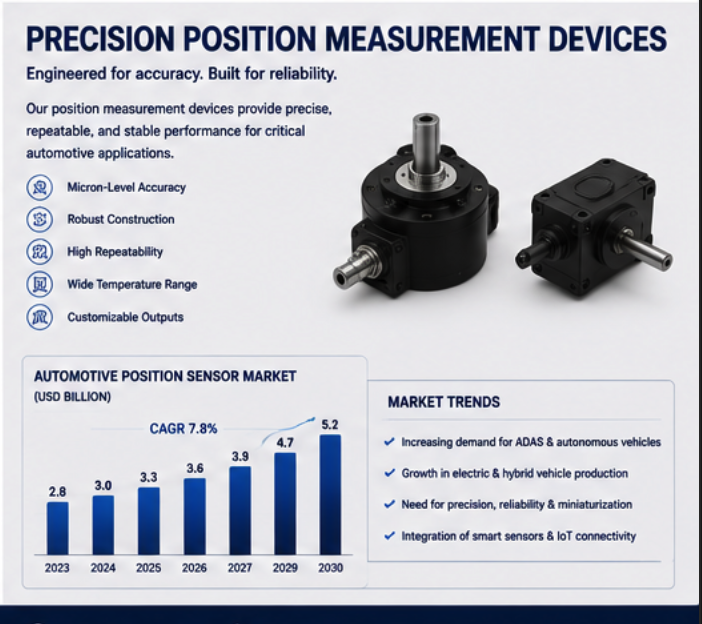
A position sensor that is accurate in a laboratory may fail miserably under a car hood. Temperature extremes, vibration, moisture, and electromagnetic interference destroy precision. Yet modern vehicles demand measurements accurate to fractions of a millimeter or tenths of a degree. Precision Position Measurement Devices are engineered to deliver this accuracy despite the harshest conditions. Understanding the metrics of precision—accuracy, resolution, repeatability, and stability—reveals the sophistication hidden inside every sensor. These devices are the foundation of Vehicle Position Sensing Technology, providing the reliable data that all other systems depend on.
Defining Precision: Accuracy vs. Resolution vs. Repeatability
Precision is not a single concept. Engineers distinguish several related metrics:
Accuracy:
How close a measurement is to the true value. A throttle position sensor with ±0.5% accuracy reads 50.0% when the true throttle opening is 50.0% (or between 49.5% and 50.5%).
Resolution:
The smallest change in position that the sensor can detect. A suspension height sensor with 0.1 mm resolution can distinguish between 10.0 mm and 10.1 mm of travel.
Repeatability:
The sensor's ability to produce the same output for the same input over multiple measurements. A steering angle sensor with 0.05° repeatability returns the same angle measurement each time the wheel is turned to that position.
Linearity:
How consistently the sensor's output changes with position. A perfect linear sensor outputs 0V at 0mm, 1V at 10mm, 2V at 20mm, etc. Real sensors have some deviation.
| Metric | Definition | Typical Automotive Spec |
|---|---|---|
| Accuracy | Closeness to true value | ±0.5% to ±1% of range |
| Resolution | Smallest detectable change | 0.01-0.1 mm or 0.01-0.1° |
| Repeatability | Same output for same input | ±0.1% of range |
| Linearity | Consistency of output change | ±0.5% of range |
| Hysteresis | Difference in output with direction | <0.2% of range |
The Challenge of Automotive Environments
Precision Position Measurement Devices must survive conditions that would destroy consumer electronics:
Temperature Extremes:
-
Underhood: -40°C to +150°C (-40°F to +300°F)
-
Cabin: -40°C to +85°C (-40°F to +185°F)
-
Effect: Materials expand and contract; electronics behave differently at temperature extremes.
Vibration and Shock:
-
Typical vibration: 10-2000 Hz, up to 10g acceleration.
-
Shock: 50g or more (potholes, speed bumps).
-
Effect: Loose connections, cracked solder joints, mechanical wear.
Contamination:
-
Water: Rain, car washes, puddles.
-
Salt: Winter road salt (corrosive).
-
Oil: Engine leaks, brake fluid.
-
Dirt/Dust: Road debris.
-
Effect: Corrosion, electrical shorts, mechanical binding.
Electromagnetic Interference (EMI):
-
Sources: Alternators, ignition systems, electric motors, mobile phones.
-
Effect: False sensor readings, communication errors.
Temperature Compensation: Keeping Measurements Accurate
Temperature affects sensor performance in several ways:
-
Magnetic field strength varies with temperature (Hall effect sensors).
-
Coil resistance changes with temperature (inductive sensors).
-
Mechanical dimensions change with thermal expansion.
To compensate, precision sensors include:
-
Temperature sensors: An internal thermometer measures the sensor's temperature.
-
Compensation algorithms: The sensor's electronics adjust the output based on the temperature reading.
-
Calibration data: Each sensor is individually calibrated across the temperature range.
Example: A Hall effect sensor's output might drop by 10% from -40°C to +150°C. The compensation circuit multiplies the output by a temperature-dependent factor to maintain accuracy.
Environmental Sealing: Keeping Contaminants Out
Automotive sensors are sealed to specific Ingress Protection (IP) ratings:
| IP Rating | Dust Protection | Water Protection |
|---|---|---|
| IP54 | Limited dust ingress | Splashing water |
| IP65 | Dust-tight | Low-pressure water jets |
| IP67 | Dust-tight | Temporary immersion (1m, 30 min) |
| IP69K | Dust-tight | High-pressure, high-temperature water jets (steam cleaning) |
Underhood sensors typically require IP67 or IP69K. Connectors are sealed with gaskets or o-rings; internal electronics are potted (encased in epoxy or silicone).
Electromagnetic Compatibility (EMC): Rejecting Interference
Automotive sensors must pass stringent EMC tests:
-
Radiated immunity: The sensor must function correctly when exposed to radio frequency fields (e.g., from a mobile phone or radio transmitter).
-
Conducted immunity: The sensor must tolerate electrical noise on its power and signal wires.
-
Radiated emissions: The sensor must not generate radio frequency interference that affects other components.
-
Electrostatic discharge (ESD): The sensor must survive static shocks (e.g., a person touching the connector).
Design techniques include:
-
Shielding: Metal housings or foil wraps block external fields.
-
Filtering: Capacitors and inductors remove noise from power and signal lines.
-
Differential signaling: Using two wires (signal+ and signal-) with opposite voltages cancels common-mode noise.
Calibration: The Key to Accuracy
No sensor is perfect. Manufacturing variations mean each sensor has slightly different characteristics. Calibration compensates for these variations.
Factory Calibration:
-
Each sensor is placed in a test fixture that moves it through its full range.
-
The sensor's output at multiple positions is recorded.
-
Correction factors are stored in the sensor's internal memory (or a lookup table in the vehicle computer).
-
The sensor (or computer) applies the correction in real-time.
End-of-Line Calibration (Vehicle Assembly):
Some sensors are calibrated after installation in the vehicle. For example:
-
The steering angle sensor is centered (wheels straight ahead).
-
The suspension height sensor zero point is set (vehicle at nominal ride height).
-
The throttle pedal sensor learns the rest position (foot off pedal).
This calibration may be automatic (the computer learns as the driver uses the component) or require a scan tool.
Automated Calibration Procedures:
Many modern sensors use "auto-calibration." The sensor continuously monitors its own output and adjusts for drift. If a throttle pedal sensor detects that the output is not returning to the same voltage each time the driver releases the pedal, it may recalibrate the "zero" position.
Sensor Failure and Graceful Degradation
Even the best sensors can fail. Precision position measurement devices are designed for graceful degradation:
-
Out-of-range detection: If the sensor output is impossible (e.g., 10V on a 0-5V sensor), the computer detects a fault.
-
Plausibility checks: The computer compares the sensor reading to other data (e.g., throttle position vs. engine airflow).
-
Redundancy: Critical sensors (throttle, brake, steering) have dual sensing elements. If one fails, the other continues.
-
Limp-home mode: If a sensor fails, the computer uses a default value (e.g., throttle set to 20% open) allowing the driver to reach a service center.
Verification and Testing
Automotive Vehicle Position Sensing Technology undergoes rigorous validation:
| Test | Description | Duration |
|---|---|---|
| Thermal cycling | Cycle between -40°C and +150°C | 500-1,000 cycles |
| Vibration | Shake at varying frequencies | 50-200 hours |
| Humidity | Expose to 95% relative humidity | 500 hours |
| Salt spray | Corrosion test | 100-500 hours |
| EMC | Radiated and conducted immunity | Hours to days |
| Durability | Mechanical cycling (e.g., pedal presses) | 1-10 million cycles |
| Life test | Operating life at elevated temperature | 1,000-5,000 hours |
Sensors that pass these tests are certified for automotive use.
The Future of Precision Position Measurement
Emerging trends in Precision Position Measurement Devices include:
-
Higher integration: Sensors with onboard processing and memory, reducing the load on the vehicle's main computers.
-
Predictive calibration: Sensors that track their own aging and adjust calibration proactively.
-
Wireless sensors: Eliminating wiring for rotating or moving components (steering wheel, wheels).
-
Self-diagnosing sensors: Sensors that can detect internal faults and report their remaining useful life.
-
Quantum sensing: Experimental sensors using atomic-scale effects for extreme precision.
Conclusion
A position sensor is only as good as its ability to measure accurately, repeatedly, and reliably—no matter the conditions. Precision Position Measurement Devices are engineered with temperature compensation, environmental sealing, electromagnetic shielding, and rigorous calibration to meet automotive demands. They are the foundation upon which Vehicle Position Sensing Technology is built. The next time your engine responds instantly to your right foot or your stability control prevents a skid, thank the precision sensors that made it possible. Perfect measurements enable perfect control.

 French