


Automated Machine Learning Platforms Democratize Predictive Analytics
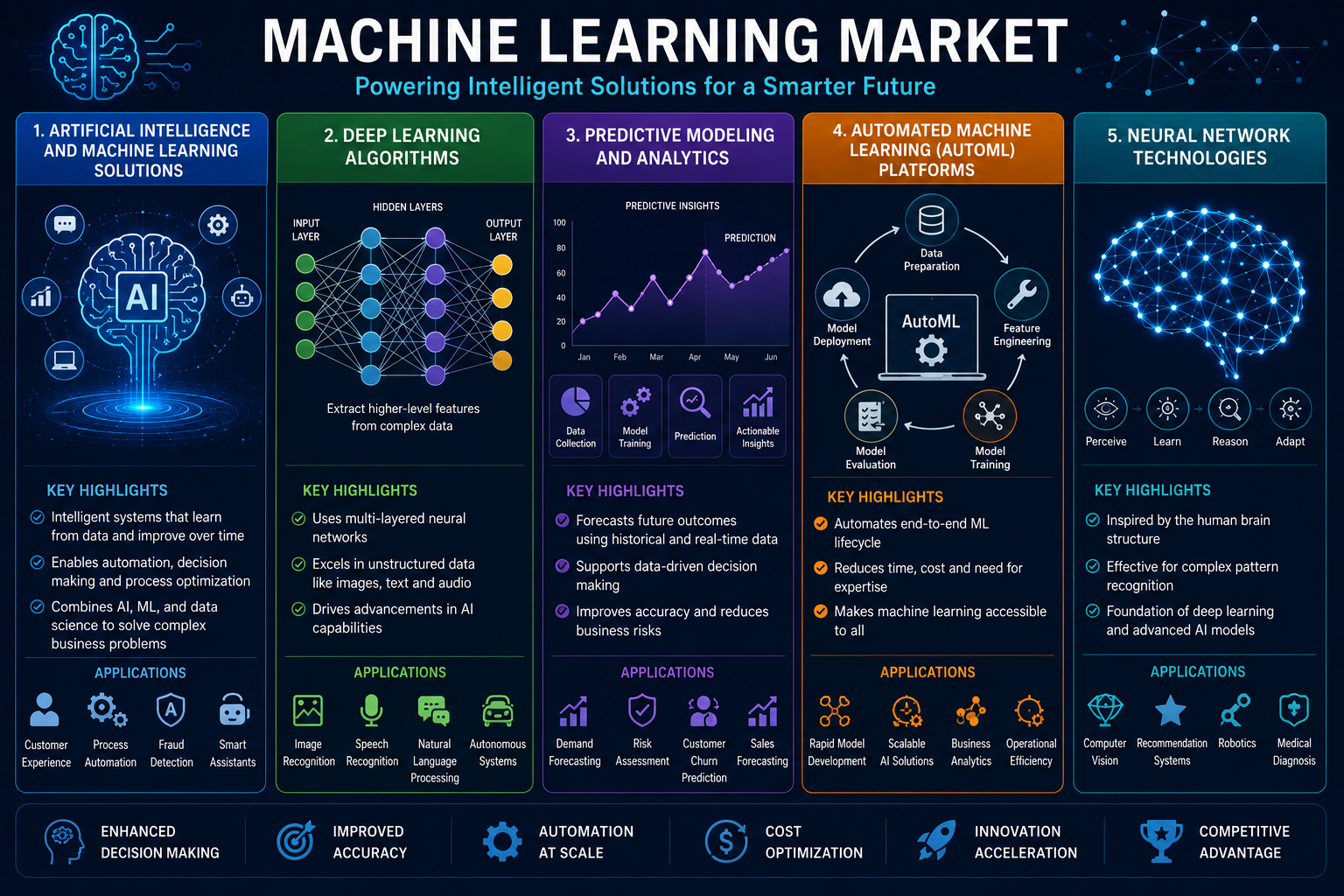
Machine learning expertise is scarce and expensive. Data scientists command high salaries. According to a market report from Market Research Future (MRFR), Automated Machine Learning Platforms and Predictive Modeling and Analytics are addressing this shortage by automating many tasks that previously required specialized skills. AutoML platforms automatically select algorithms, tune hyperparameters, engineer features, and evaluate models. Business analysts and domain experts can now build predictive models without writing code.
The impact of AutoML is democratization. Organizations that cannot afford large data science teams can still benefit from machine learning. Subject matter experts—who understand the business context best—can build models directly, without translating requirements to technical teams.
What Automated Machine Learning Platforms Deliver
Automated machine learning platforms automate the end-to-end machine learning workflow. Data preparation includes automated cleaning, imputation of missing values, and encoding of categorical variables. Feature engineering automatically creates informative features from raw data through transformations, interactions, and aggregations. Algorithm selection tests multiple algorithms (linear regression, decision trees, gradient boosting, neural networks) and selects the best. Hyperparameter tuning searches for optimal algorithm settings. Model evaluation uses cross-validation to estimate performance on unseen data. Ensemble methods combine multiple models for improved accuracy.
A marketing analyst at a retail company might use an AutoML platform to predict customer churn. The analyst uploads a CSV file with customer data: demographics, purchase history, support interactions, and a column indicating whether the customer churned. The AutoML platform automatically processes the data, engineers features, tests dozens of models, and outputs a churn prediction model. The analyst deploys the model to identify at-risk customers for retention offers. No data science expertise required.
The MRFR report notes that AutoML platforms are not equally capable across all problem types. They perform best on tabular data (rows and columns) with clear prediction targets. For unstructured data (images, text, audio) or unusual problem formulations, custom modeling may still be required.
Predictive Modeling and Analytics as the Application Layer
AutoML platforms generate predictive models; predictive modeling and analytics systems apply those models to business problems. The integration between AutoML and predictive analytics is seamless in modern platforms. A model built in AutoML can be deployed with a few clicks, generating predictions on new data in real time or batch.
A bank might use an AutoML platform to build a credit risk model. The platform automatically processes loan application data, tests dozens of algorithms, and selects a gradient boosting model with 85 percent accuracy. The bank deploys the model to its loan origination system. Each new application receives a risk score. Applications below a threshold are automatically approved; above a threshold are sent for manual review.
The MRFR report emphasizes that AutoML reduces but does not eliminate the need for human judgment. The analyst must still define the prediction target correctly, ensure the training data is representative, and validate that the model is not biased or using inappropriate features. AutoML automates the mechanics; the human provides the context.
Interpretability and Explainability
One concern with AutoML is that the resulting models may be black boxes. Many AutoML platforms include interpretability features that explain why a model made a particular prediction. Feature importance shows which inputs most influenced the model. SHAP values explain each prediction in terms of feature contributions. What-if analysis shows how changing an input changes the prediction.
A healthcare provider using an AutoML model to predict readmission risk needs to explain predictions to clinicians. The AutoML platform provides SHAP values for each patient: "This patient's readmission risk is high because they have three previous admissions (contribution +0.3), diabetes (contribution +0.2), and live alone (contribution +0.1)." The clinician understands why the patient is flagged and what interventions might help.
Time-to-Value and Cost
The MRFR report documents significant time savings from AutoML. A predictive modeling project that might take a data scientist days or weeks can be completed by a business analyst in hours. This acceleration enables organizations to tackle more problems and iterate more quickly.
An insurance company might use AutoML to build models for multiple business problems: claims fraud, customer retention, risk pricing, and marketing response. A small analytics team manages dozens of models simultaneously, something that would be impossible without automation.
The cost savings are also substantial. Organizations that would need to hire three data scientists can hire one data scientist to oversee AutoML outputs while business analysts build models directly. The data scientist focuses on complex problems where AutoML is insufficient.
Limitations and When to Avoid AutoML
AutoML is not a universal solution. For problems with very large datasets (hundreds of millions of rows) or very high-dimensional data (tens of thousands of features), AutoML may be inefficient. Custom solutions optimized for the specific problem may be required.
For problems requiring novel algorithms or custom loss functions, AutoML may not apply. A research organization developing a new type of neural network would not use AutoML.
For regulated industries requiring complete model transparency, the black-box nature of some AutoML models may be problematic. Simpler models built manually may be preferred even if they are less accurate.
Conclusion
Machine learning should not be reserved for specialists. Automated Machine Learning Platforms automate the technical complexity of building predictive models, enabling business analysts to become model builders. Predictive Modeling and Analytics provide the application layer that puts models to work. Together, they democratize predictive analytics across the enterprise.

 French