


Watching the Viewers: How Smart TV Analytics Solutions and Digital Content Identification Revolutionize Audience Measurement
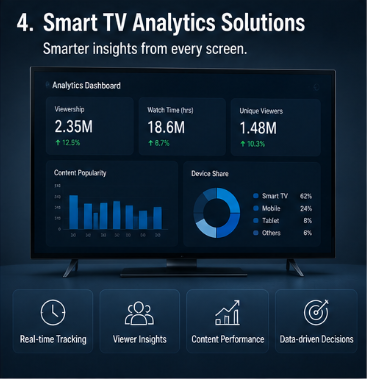
Audience measurement once relied on small panels of viewers who recorded what they watched. This approach provided directional data but missed the full picture—what viewers actually watched, when they watched, and how they engaged. Smart TV Analytics Solutions have transformed measurement by collecting data directly from smart televisions and streaming devices. Instead of asking a panel what they watched, these systems observe actual viewing behavior across millions of televisions. The result is measurement at unprecedented scale, granularity, and accuracy. Content owners know exactly how many viewers watched each program, when they tuned in, when they tuned out, and what they watched before and after.
This granular measurement relies on Digital Content Identification to determine what content is playing on each device at each moment. Unlike panel-based measurement, which relies on viewers to identify what they are watching, smart TV analytics identify content automatically using audio and video fingerprinting. The television listens to its own audio, generates a fingerprint, and matches it against a reference database. The result is passive, automatic identification that requires no action from the viewer and produces data far more accurate than self-reporting.
The Evolution of Audience Measurement
Understanding smart TV analytics requires understanding the limitations of traditional measurement approaches.
Panel-Based Measurement
Traditional audience measurement used panels—small groups of households selected to represent the broader population. Panel members recorded what they watched, either in diaries or through passive meters attached to their televisions. Sample sizes were limited by cost, with even the largest panels including only tens of thousands of households. Extrapolating from small samples to national populations introduced significant statistical error, particularly for niche programming and local markets.
Set-Top Box Data
Cable and satellite set-top boxes provided another data source, capturing what channels were tuned at each moment. This data covered millions of households, far larger than panel samples. However, set-top box data could not distinguish between content viewed actively and content playing to an empty room. It could not identify streaming content delivered over the internet. And it provided no information about who was watching, only that the television was on.
Smart TV Analytics
Smart TV analytics combine the scale of set-top box data with the granularity of content identification. Modern smart televisions have powerful processors and always-on internet connections. They can run content recognition algorithms locally, identifying what is on screen without sending video or audio off the device. The resulting data—program identified, timestamp, viewing duration—can be aggregated and analyzed to produce audience measurement with unprecedented precision.
How Smart TV Analytics Work
Smart TV analytics systems are designed to be privacy-preserving while delivering accurate measurement.
On-Device Fingerprinting
The most privacy-conscious smart TV analytics systems perform fingerprinting entirely on the device. The television listens to its own audio or captures frames from the video stream, generates fingerprints, and compares them to a reference database stored locally or accessed through anonymized queries. The actual audio and video never leave the device—only the identification results, which contain no media content, are transmitted.
Reference Database Synchronization
The reference database contains fingerprints for every program, commercial, and other content that might air on television. This database is synchronized to smart televisions periodically, enabling on-device matching without continuous cloud queries. For live events like breaking news or sports, cloud-based matching may be used to identify content that was not pre-loaded.
Data Aggregation and Reporting
Individual viewing events—a household watched a specific program from 8:00 to 8:30 PM—are aggregated and anonymized before reporting. A typical report might show that a program had 10 million viewers, with demographic breakdowns, but no individual household data. This aggregation protects viewer privacy while providing the measurement that content owners and advertisers need.
Applications of Smart TV Analytics
Content Performance Measurement
Television networks use smart TV analytics to measure program performance. How many viewers watched each episode? How long did they watch? At what point did viewers tune out? How many watched live versus time-shifted? This data informs programming decisions, marketing spend, and renewal decisions.
Advertising Effectiveness
Advertisers use smart TV analytics to measure advertising effectiveness. How many viewers saw each commercial? How many watched the entire commercial versus skipping or changing channels? What actions did viewers take after seeing the commercial—searching for a product, visiting a website, making a purchase? Smart TV data can be linked to other data sources to measure full-funnel outcomes.
Competitive Intelligence
Networks monitor competitors' performance using smart TV analytics. Which programs are gaining or losing viewers? Which time slots are most competitive? How do different programming strategies perform? This intelligence informs scheduling decisions and content acquisition strategies.
Real-World Impact: Case Studies
The Television Network
A major television network used smart TV analytics to optimize its fall schedule. Traditional measurement showed a program performing adequately, but smart TV data revealed that most viewers tuned out during the second commercial break. The network adjusted the program's pacing, moving a key plot point before the break. Retention improved dramatically, and the program went on to become a hit.
The Consumer Packaged Goods Company
A consumer packaged goods company used smart TV analytics to measure advertising effectiveness for a new product launch. Traditional measurement would have reported reach and frequency—how many households saw the ad, how many times. Smart TV data went further, linking ad exposure to online search behavior. Households that saw the ad were significantly more likely to search for the product, enabling a direct return-on-ad-spend calculation.
The Streaming Service
A streaming service used smart TV analytics to understand how viewers discovered its content. Traditional measurement showed that some viewers came from social media, some from word of mouth, some from other sources. Smart TV data revealed that many viewers watched a particular program after seeing its trailer during a popular sporting event. The service shifted marketing spend to sports programming, acquiring new subscribers at lower cost.
Privacy and Ethical Considerations
Transparency and Consent
Smart TV analytics raise privacy concerns that responsible implementers address through transparency and consent. Viewers should know that their television is collecting viewing data. They should have the opportunity to opt out. And their choices should be respected across the platform.
Data Minimization
Responsible smart TV analytics practice data minimization—collecting only the data necessary for the intended purpose. A system measuring program viewership does not need to know what individual household members say while watching. It does not need video or audio recordings. It does not need to share data with unaffiliated third parties without explicit consent.
Regulatory Compliance
Smart TV analytics must comply with privacy regulations in all jurisdictions where they operate. The European Union's General Data Protection Regulation imposes strict requirements for data collection and processing. California's Consumer Privacy Act provides similar protections. Compliance requires ongoing attention as regulations evolve.

 French