


The Power Train Explained: A Deep Dive into Electric Bike Powertrain Components
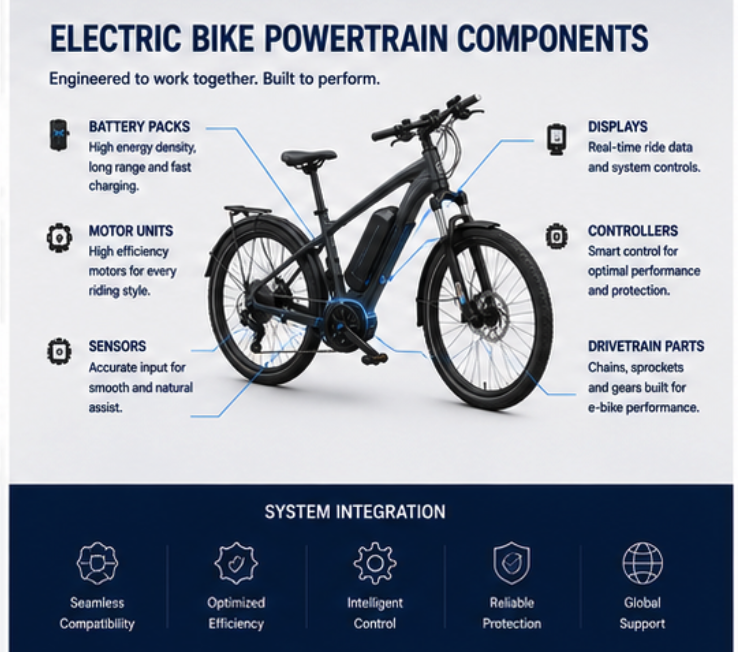
An electric bicycle is far more than a bicycle with a motor bolted on. It is an integrated electro-mechanical system where every component influences the performance, range, and feel of the ride. The Electric Bike Powertrain Components—motor, battery, controller, sensors, and drivetrain—must be carefully matched to deliver a cohesive experience. Central to this system is the selection of Battery-Powered Bicycle Propulsion technology, which determines the bike's range, weight, and environmental footprint. Understanding these components empowers consumers to make informed purchase decisions and maintain their e-bikes effectively.
The Motor: The Prime Mover
The motor is the most visible powertrain component. As discussed previously, motors fall into two categories: hub motors (in the wheel) and mid-drive motors (at the bottom bracket). Key specifications to evaluate include:
-
Nominal power (W): Continuous power the motor can sustain (250W, 500W, 750W).
-
Peak power (W): Short-term maximum power, typically 2x nominal.
-
Torque (Nm): Rotational force at the crank (mid-drive) or wheel (hub). Higher torque improves climbing.
-
Weight (kg): Motor weight affects overall bike weight and handling.
For Battery-Powered Bicycle Propulsion, motor efficiency is paramount. A motor that converts 85% of electrical energy to mechanical energy (vs. 70%) provides 20% more range from the same battery.
The Battery: The Energy Reservoir
The battery is the single most expensive powertrain component (typically $300-800). All modern e-bikes use lithium-ion cells, but quality varies dramatically:
-
Cell type: 18650 or 21700 cylindrical cells from Tier-1 manufacturers (Samsung, LG, Panasonic, Murata) are preferred over generic Chinese cells.
-
Capacity (Wh): Watt-hours = voltage x amp-hours. A 36V 14Ah battery = 504 Wh. Common capacities range from 250 Wh to 1,000 Wh.
-
Voltage (V): 36V and 48V are standard. Higher voltage allows lower current for the same power, reducing losses.
-
Weight (kg): Energy density varies from 150-250 Wh/kg. Lighter batteries use higher-density cells.
Battery management systems (BMS) are critical safety components. A quality BMS protects against over-current, over-voltage, under-voltage, short circuits, and temperature extremes. Cheap batteries may lack full BMS functionality, posing fire risks.
The Controller: The Brain
The controller is the least visible but most technically sophisticated powertrain component. It regulates current from the battery to the motor based on sensor inputs and rider mode selection.
Key controller features:
-
Current limiting: Prevents excessive current that could damage motor or battery.
-
Thermal protection: Reduces power or shuts down if overheating.
-
Regenerative braking (hub motors only): Converts the motor to a generator, feeding energy back to the battery.
-
Communication protocol: CAN bus (premium) or UART (budget) for display and sensor integration.
Advanced controllers use Field-Oriented Control (FOC) algorithms. FOC precisely regulates motor phase currents, resulting in smooth, quiet, efficient operation. FOC controllers are more expensive but provide a superior riding experience.
Sensors: The Nervous System
Electric Bike Powertrain Components rely on several sensors to determine appropriate power delivery:
| Sensor | Function | Location |
|---|---|---|
| Torque sensor | Measures pedaling force | Bottom bracket axle |
| Cadence sensor | Detects pedaling rotation | Crank arm or bottom bracket |
| Speed sensor | Measures wheel speed | Frame near rear wheel magnet |
| Motor temperature | Prevents overheating | Inside motor windings |
| Battery temperature | Prevents thermal runaway | Inside battery pack |
| Brake sensors | Cut power when braking | Brake levers |
The interaction between torque and cadence sensors determines the "natural feel" of the Battery-Powered Bicycle Propulsion system. High-quality systems use both; budget systems may use cadence alone.
The Drivetrain: The Mechanical Link
The final powertrain component is the mechanical drivetrain—chain, cassette, chainring, and derailleur. For mid-drive e-bikes, these components experience higher torque and wear faster. Recommended upgrades include:
-
E-bike specific chains: Hardened pins and plates (e.g., Shimano CN-E6090, KMC E8/E9/E10).
-
Reinforced cassettes: Steel or nickel-plated steel (aluminum cassettes wear too quickly).
-
Steel chainrings: Aluminum chainrings wear rapidly under motor torque.
-
Internal gear hubs: Enclosed gears (Shimano Alfine, Rohloff) require less maintenance and tolerate higher torque.
Hub motor e-bikes, conversely, place no additional torque on the drivetrain. Standard bicycle chains and cassettes perform fine, and internal gear hubs are optional rather than necessary.
Integration: The Ecosystem Approach
The trend in premium e-bikes is toward fully integrated powertrain ecosystems. Bosch, Shimano, and Yamaha offer matched sets of motor, battery, controller, display, and sensors designed to work together. Benefits include:
-
Plug-and-play compatibility: No wiring issues or configuration headaches.
-
Optimized communication: Faster sensor response, smoother power delivery.
-
Centralized diagnostics: A single app or display shows all system status.
-
Over-the-air updates: Firmware improvements for all components.
The downside is vendor lock-in. Bosch batteries only work with Bosch motors; Shimano displays only work with Shimano systems. Open-platform systems (e.g., Bafang) offer flexibility but require more technical knowledge.
Conclusion
The modern e-bike is a marvel of electro-mechanical integration. Understanding the Electric Bike Powertrain Components—motor, battery, controller, sensors, and drivetrain—allows consumers to make informed choices and maintain their bikes effectively. As Battery-Powered Bicycle Propulsion technology continues to advance, powertrain components will become lighter, more efficient, and more intelligent. The result will be e-bikes that feel less like machines and more like a natural extension of the rider.

 French