


Why Women’s Motorcycle Gear Often Fits Wrong and How to Keep the Armor Where It Belongs
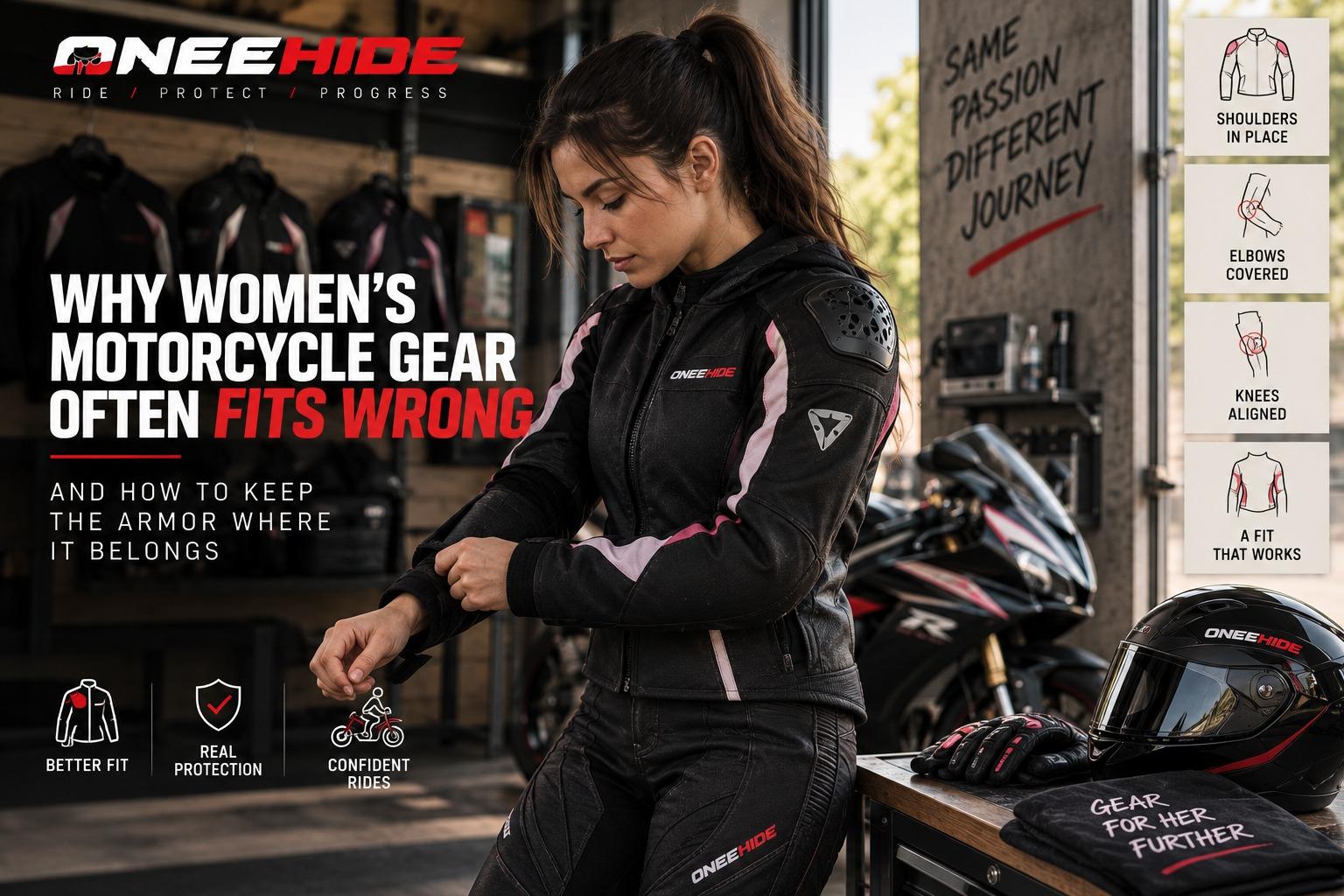
A motorcycle jacket can close cleanly, a pair of riding pants can feel comfortable, and the size label can match the chart, yet the protective fit can still be wrong. For women riders, one of the most important fit questions is not simply whether the garment feels tight or loose. It is whether the protective components actually remain over the body areas they are intended to protect.
Shoulder armor that hangs toward the upper arm, knee protectors that drop below the kneecap when standing, or elbow armor that rotates away when the arms are bent can turn an apparently well-fitting garment into a poor protective match. The challenge is that everyday clothing habits can make these problems surprisingly easy to overlook.
Motorcycle gear has to fit the rider and the armor
Protective motorcycle clothing performs several jobs at once. The outer garment has to provide appropriate coverage and resistance to the hazards it was designed for, while impact protectors need to remain positioned over areas such as the shoulders, elbows, hips and knees.
That is why shopping for women's motorcycle gear should involve more than choosing the usual casual-clothing size. The cut of the garment, torso length, arm and leg proportions, adjustment systems and the location of the armor pockets all affect how the equipment sits once the rider is on the motorcycle.
This distinction matters because impact protection is designed around coverage of particular body regions. A protector may meet a recognized impact standard, but the certification of the protector itself cannot compensate for a garment that allows it to sit in the wrong place on a particular rider.
A real-world crash study involving 212 motorcyclists found that motorcycle clothing fitted with body armor was associated with lower risks of injury in several protected regions. The reported relative risk was 0.77 for upper-body injury and 0.60 for leg injury among riders wearing fitted armor. The researchers did not find evidence that armor reduced fracture risk, so the findings should not be interpreted as a guarantee against injury. They do, however, reinforce the practical importance of properly fitted protective equipment. The study is indexed by PubMed
Why women’s motorcycle gear can fit incorrectly
Women's bodies do not follow one proportion, just as men's bodies do not. Problems arise when a garment's underlying pattern assumes a particular relationship between the bust, waist, hips, torso length, arms and legs that does not match the individual rider.
Two riders may have the same bust measurement but very different shoulder widths, waist dimensions and torso lengths. Two riders who need the same waist size may have substantially different hip, thigh or inseam measurements. Scaling every part of a garment upward or downward from one base pattern cannot accommodate all of those combinations.
Research in other forms of protective body armor illustrates the broader design problem. A study involving 97 female Australian soldiers collected 22 breast and torso measurements and found that 16 were significantly related to perceived armor fit. Although military body armor and motorcycle clothing are different products, the finding is useful from an ergonomic perspective: a single circumference measurement does not fully describe how protective equipment will interact with the female torso.
This is also why the words "women's fit" alone do not guarantee a good fit. One manufacturer may use more waist suppression and additional hip room. Another may design for a straighter silhouette. Sleeve lengths, shoulder widths, knee positions and available short or tall sizes can differ even when the nominal size is identical.
The correct question is therefore not, "What size am I?" It is, "Which size and pattern keep this particular garment and its protectors correctly positioned on my body?"
Armor position should be checked in riding posture
A motorcycle garment should be evaluated in the position in which it will actually be used. Standing upright in front of a mirror is useful for an initial check, but it does not reproduce what happens when the knees bend, the hips flex, the arms reach toward the handlebars and the torso leans forward.
Check shoulder and elbow protection together
Shoulder armor should cup or cover the intended shoulder region rather than hanging noticeably down the arm or floating away from the body. Move both arms forward as though holding the bars. The protector should move with the shoulder without becoming excessively displaced.
Elbow protection needs an equally practical test. Bend the arm through the riding range and check whether the protector stays centered over the elbow instead of rotating toward the inside or outside of the arm.
A loose sleeve may feel comfortable around town, but excess circumference can give the protector space to move. At the opposite extreme, an excessively tight sleeve can restrict comfortable control movement. The goal is secure positioning without creating meaningful restriction.
Check knees and hips while seated
Knee armor frequently causes confusion because its location can change when the rider sits down. A protector that looks slightly low while standing may move into the correct position when the knee bends.
Sit on the motorcycle, or reproduce the riding posture safely while stationary. The main protective area should align with the knee rather than ending up on the upper shin or far above the joint.
Then shift forward and backward as you normally would while riding. If the knee protector consistently rotates away from the knee, the issue may be trouser width, armor-pocket placement or an incorrect garment size rather than the protector itself.
Hip armor should likewise cover the intended area without folding, floating significantly away from the body or being pulled out of position by trousers that are too loose at the waist or too tight through the seat.
Size charts are a starting point, not a fit verdict
Choosing motorcycle gear based only on a familiar dress or jeans size is risky because sizing conventions vary between manufacturers. Body measurements are more useful.
For jackets, measurements commonly worth comparing include:
-
Full bust or chest circumference
-
Waist circumference
-
Hip circumference where relevant to jacket length
-
Sleeve and arm proportions
-
Overall height and torso length
For riding pants, waist and hip measurements should be considered alongside inseam, thigh proportions and the location of the knee.
The size chart still needs to be followed according to the individual manufacturer's measuring instructions. A medium in one brand should not be assumed to correspond perfectly to a medium elsewhere.
If your bust measurement points toward one size but your waist or hips indicate another, do not automatically choose whichever number is largest and assume the problem is solved. Look at the garment's cut, adjustment range and available alternative lengths. Sizing up far enough to accommodate one body area can make another area unnecessarily loose, which may affect armor retention.
Adjustment systems can correct small differences, not the wrong pattern
Waist straps, sleeve adjusters, hook-and-loop tabs, stretch panels and adjustable armor pockets are valuable because human bodies do not match garment blocks perfectly.
They work best when the basic garment already fits reasonably well.
For example, a sleeve adjuster can remove moderate excess volume around the forearm and help stabilize an elbow protector. It cannot reliably correct a jacket whose entire shoulder and arm pattern is several sizes too large. An adjustable knee pocket can move armor a few centimeters into a better position, but it cannot fully compensate for trousers with fundamentally unsuitable proportions.
This creates a useful distinction when trying on gear:
Adjustment solves refinement. Correct sizing and pattern solve fit.
If multiple straps need to be pulled to their limits before the armor becomes stable, trying another size or cut is usually more sensible than forcing the garment to work.
What CE standards tell you about motorcycle protection
Protective certification is another part of the buying decision, but garment certification and fit should be evaluated separately.
The EN 17092 series covers protective garments for motorcycle riders. It includes garment classes such as AAA, AA and A, with different requirements and intended balances between protection and ergonomic considerations. BSI describes Class AAA garments as meeting higher requirements than AA and A garments, while noting that higher-performing configurations can carry weight, ergonomic or thermal trade-offs. BSI's EN 17092 information
Impact protectors for motorcycle limb joints are covered by EN 1621-1. SATRA notes that the standard specifies two performance levels and evaluates transmitted impact force. For Level 1, the standard's overall mean transmitted-force limit is 35 kN, with additional limits applying to individual impacts. Lower transmitted force represents greater impact attenuation under the test conditions. SATRA's explanation of EN 1621 impact-protector testing
Those numbers describe laboratory performance of the protector. They do not tell you whether a particular jacket will place that protector correctly over your elbow.
European PPE rules make the ergonomic principle explicit at a broader level. Regulation (EU) 2016/425 requires applicable PPE to satisfy essential health and safety requirements and states that PPE should be designed so the user can perform the relevant activity normally while receiving appropriate protection. Regulation (EU) 2016/425
Certification, construction and fit therefore answer different questions. A rider should consider all three.
A simple fit test before keeping a jacket or pair of pants
Once the correct size appears to be selected, evaluate the gear as protective equipment rather than fashion clothing.
Put on the same type of base layers you expect to wear while riding. Close the zippers and fasteners completely. Then reproduce your normal riding position.
Check the following:
-
Shoulder armor remains centered when you reach toward the handlebars.
-
Elbow armor covers the elbow with the arm bent and does not rotate excessively.
-
Knee armor moves into the correct position when the knee is flexed.
-
Hip protection sits over the intended area rather than hanging loosely.
-
Sleeves and trouser legs are long enough in riding posture.
-
The jacket does not rise enough to expose an unacceptable gap at the waist.
-
Normal steering, braking, shifting and body movement are not significantly restricted.
-
Adjustment straps still have useful range rather than sitting permanently at one extreme.
Repeat the movement test several times. Protective positioning that disappears as soon as you change posture is a warning sign.
When unisex or men’s gear can still fit
Women's-specific gear is not automatically the correct answer for every woman. Some riders have body proportions that match a straight or traditionally men's cut better than a heavily shaped women's pattern.
That is not a problem if the garment performs correctly.
The test remains the same: does the garment provide appropriate coverage, allow normal motorcycle control and keep its protectors properly positioned?
A men's or unisex jacket that fits securely across the shoulders and arms may be preferable to a women's jacket that fits the waist attractively but leaves the shoulder protectors unstable. Conversely, sizing up a men's garment simply to accommodate the hips may create too much volume through the torso and sleeves.
Labels should guide the search, not decide it.
Replace gear when body or garment changes affect the fit
A garment that fitted correctly when purchased should not be assumed to fit identically forever.
Body measurements can change. Textile materials, adjustment systems and liners can change how the garment sits. Removing a thermal liner may create noticeably more internal space. Adding thick winter layers may move or compress protective components. Armor itself can also be replaced with protectors of a different shape or thickness.
Recheck fit after significant changes.
The same principle applies after washing protective clothing. Follow the manufacturer's care instructions, particularly because some standards specifically evaluate dimensional stability when garments are intended to be washed or dry cleaned. SATRA's overview of EN 17092 notes a dimensional-change requirement of no more than plus or minus 5 percent under the referenced test procedure.
If armor pockets, hook-and-loop retainers, adjustment straps or garment seams become damaged, correct protector positioning may no longer be reliable even if the garment still looks wearable.
Choose the garment that protects in the position you actually ride
A good motorcycle fit is neither the loosest option that feels comfortable nor the tightest garment you can zip closed.
Look for a secure base fit, enough mobility to operate the motorcycle normally, and armor that remains aligned with the relevant body regions as you move. Use measurements to narrow the search, then let riding-position fit determine whether the garment genuinely works.
Women's sizing can reduce some common proportion problems, but the label itself is not the objective. The objective is simpler: when you bend your knees, reach for the bars, shift in the seat and move naturally on the motorcycle, the protective equipment should still be where it is supposed to be.

 English